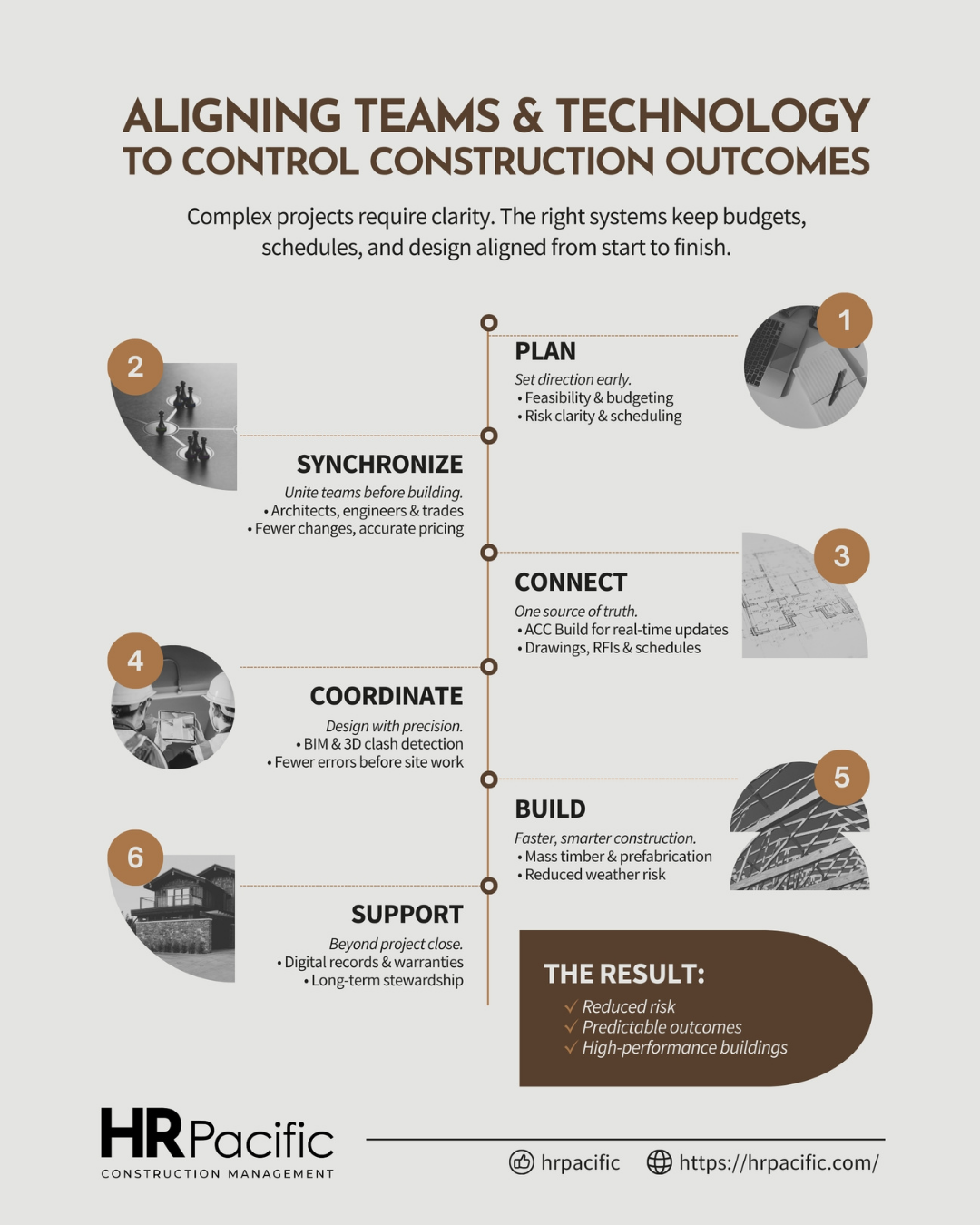
Construction projects involve complex logistics. They require strict coordination between architects, engineers, trades, and suppliers. Experienced teams can manage this complexity through a structured process and specific digital technologies. This approach prioritizes clarity. It ensures that budgets, schedules, and design intent remain aligned from the initial planning stages through to completion.
The following are ways your chosen construction management team can ensure your projects are completed smoothly and successfully.
Structured Project Planning and Feasibility
Risk management and risk clarity begins long before the ground is broken. The Project Planning & Consultation phase establishes feasibility. Clients receive early guidance on zoning, site analysis, budgets, and schedules. This prevents design concepts from advancing too far without a realistic grounding in cost and constructibility.
The Pre-Construction Coordination phase subsequently aligns architects, consultants, and trades. In this phase, parties should review drawings and address constructability issues early. This minimizes redesigns and prevents costly changes later in the project. This phase also allows the team to secure accurate pricing before markets shift. Clients are protected against budget surprises. In regions with short building seasons, such as Golden or Invermere, this early planning allows for realistic scheduling that accounts for weather windows and access constraints.
Digital Transparency with ACC Build
Using Autodesk Construction Cloud Build (ACC Build) can centralize project information. This platform hosts drawings, Requests for Information (RFIs), schedules, and updates in real time.
This system provides complete visibility for all stakeholders. Architects and consultants access the same up-to-date information as the site crew. This reduces duplication and errors. Homeowners and clients can log in to track milestones directly. This removes uncertainty regarding project progress and reduces the anxiety often associated with construction schedules.
Precision Through Building Information Modeling (BIM)
Building Information Modeling (BIM) consolidates design and engineering data into a 3D model. This enables the construction team to detect clashes between architectural, structural, electrical, and mechanical systems before fabrication begins.
Teams such as HR Pacific employ internal expertise to manage this process. Geoff Ratzlaff, our BIM and VDC Manager, applies nearly two decades of architectural technology experience to ensure digital tools translate into better outcomes on the ground. The model generates accurate documentation and creates reliable as-built records. Commercial clients use these records to reduce maintenance costs by having a clear digital roadmap of the facility. Homeowners utilize this data to plan future renovations with accuracy.
Mass Timber and Off-Site Fabrication
Advanced materials also play a role in construction risk management and schedule certainty. The utilization of mass timber products, such as CLT and glulam. These components enable large spans and reduce the project’s carbon footprint. They are often part of an off-site fabrication strategy.
Prefabricated assemblies are built in controlled environments. This eliminates weather risk and improves quality. When delivered to the site, they install quickly. This reduces disruption and shortens schedules. Projects like the Blenheim Residence demonstrate how mass timber-based systems deliver award-winning results through this precise methodology when paired with early coordination and digital planning.
Long-Term Stewardship
The process continues after the build is complete. A proper construction manager extends the partnership beyond handover through Post-Construction Stewardship. Clients receive digital records and warranty support. For remote or vacation properties, stewardship programs include seasonal checks and system monitoring. This ensures that heating and water systems remain operational even when the owner is absent.
These systems work together to protect the client’s investment. By integrating detailed planning with digital tools and post-construction care, teams like HR Pacific deliver projects that meet rigorous quality and performance standards over the full life of the building.