
Design-build is a collaborative project delivery method that covers both design and construction under a single agreement and a unified team. The owner interacts with a lone entity that manages the full scope of the project. It aligns architects, engineers, contractors, and owners from the outset. This structure supports earlier coordination, clearer information flow, and stronger alignment between design intent and construction execution.
This article explains how the design-build process works, how it differs from traditional models, and why owners and contractors are adopting it. It covers collaboration, risk reduction, the role of BIM and digital tools, and how to get started with design-build construction. The goal is to provide clarity for owners evaluating delivery options and contractors considering an integrated project delivery method.
Design-build construction is a delivery system in which one cohesive team manages responsibilities for both design and construction. This team includes construction professionals such as architects, engineers, builders, trades, and project managers who work together from concept to completion. This unified arrangement makes for easier communication for the owner and the project team.
HR Pacific operates this way across its projects. A typical HR Pacific design-build team includes a project manager, a full-time superintendent, a Building Information Manager (BIM) and Virtual Design Construction (VDC) manager, and administrative support. HR Pacific’s internal staff and long-standing subcontractor partners provide stability throughout the design-build process. This structure supports integrated project delivery and consistent execution throughout the project.
Design-build construction in Canada has increased across both public and private sectors. Provincial authorities have expanded eligibility for design-build procurement, particularly in infrastructure and institutional work outlined by Infrastructure Canada. The method is now common in transportation, water treatment, and civic facilities. Private owners in Canada have followed this trend for residential, hospitality, resort, and commercial projects due to the model’s predictability and risk consolidation. In resort, mountain, and remote developments, early contractor involvement is particularly valuable due to constrained access, seasonal construction windows, logistics planning, and heightened sensitivity to site conditions. This model is also aligned with modern BIM and similar digital tools that allow designers and builders to collaborate using shared platforms.
Across North America, design-build continues to grow. Data from the Design-Build Institute of America (DBIA) indicate that design-build will continue to rise across the United States. Several states now have full or broad authorization to use design-build for major public infrastructure. With this shift, design-build has become a standard delivery model rather than an alternative approach.
The traditional method of design-bid-build separates design and construction into distinct phases, with designers completing drawings before contractors bid, leading to limited collaboration and potential delays.
This sequence creates phased handoffs, limiting collaboration. When changes occur during construction, teams often react within their own scopes. The prime consultant or owner becomes the central coordinator, responsible for resolving conflicts between design and construction. The fragmented workflow increases the possibility of cost changes, schedule delays, and communication gaps.
Design-build consolidates design and construction into one team. The owner works with one entity that manages the entire process. Architects, engineers, and construction teams collaborate from the first stage of planning. This integration reduces rework and strengthens alignment between design intent and construction requirements. However, these benefits depend on disciplined coordination and clearly defined roles, not simply contractual structure.
HR Pacific’s use of digital tools such as Autodesk Construction Cloud gives owners real-time visibility, fostering confidence in project management.
These systems function as design-build project management software and support organized, collaborative construction management.
Design-build provides several advantages for Canadian and North American projects.
Because design and construction progress in overlapping phases, procurement and early site work can commence before all design details are finalized.
Earlier Cost Visibility
Construction insight informs early budget planning. HR Pacific begins with Class D estimates when design information is limited, and budgets are reviewed frequently as drawings advance, providing owners with clearer cost visibility earlier in the process and improving confidence in budget management and financial predictability.
Design-build relies on shared information, fostering transparency that reassures owners and stakeholders. BIM in design-build allows coordinated review of models and drawings. HR Pacific’s digital systems support document control and structured communication.
Single-source contracting is utilized in design-build construction. Under a design-build contract, owners manage a single agreement instead of coordinating separate contracts for design and construction. This consolidates accountability and reduces the owner’s administrative load. Research from the Construction Industry Institute (CII) shows that integrated delivery models, such as design-build, reduce disputes and improve costs and schedule performance.
Risk is more clearly defined rather than eliminated, providing clearer responsibility when decisions or changes arise.
The design-build process follows several phases that emphasize transparent communication and early coordination.
The owner and design-build team establish performance criteria, scope, preliminary schedule, and target budget. Designers and builders assess site conditions and develop early concepts. HR Pacific engages surveyors and geotechnical engineers during this stage.
For mountain and remote sites, early geotechnical review, access planning, and construction sequencing are particularly critical.
Architects, engineers, and builders coordinate drawings and specifications. Budget information is updated as decisions are made. HR Pacific’s process includes recurring budget reviews throughout design development, value engineering support, and close coordination with surveyors and geotechnical engineers.
Construction begins once early packages are completed. The HR Pacific team self-performs key carpentry scopes, which improves quality control, framing accuracy, and sequencing. HR Pacific obtains three (3) competitive bids per trade for most scopes. Site superintendents manage daily work, while project managers coordinate documentation, procurement, and scheduling.
The unified team provides final documentation, closeout materials, and training. Continuity between design and construction reduces handoff friction and closeout inefficiencies.
Canadian construction requires planning for winter conditions, frost depth, slope stability, seismic zones, and regional drainage patterns. Integrated teams can respond to these variables through early technical decisions, coordinated scheduling, and real-time communication with municipal inspectors.
Remote mountain sites, common in British Columbia, require precise sequencing and route planning. Design-build supports this by aligning logistics, structure, and design requirements before construction begins.
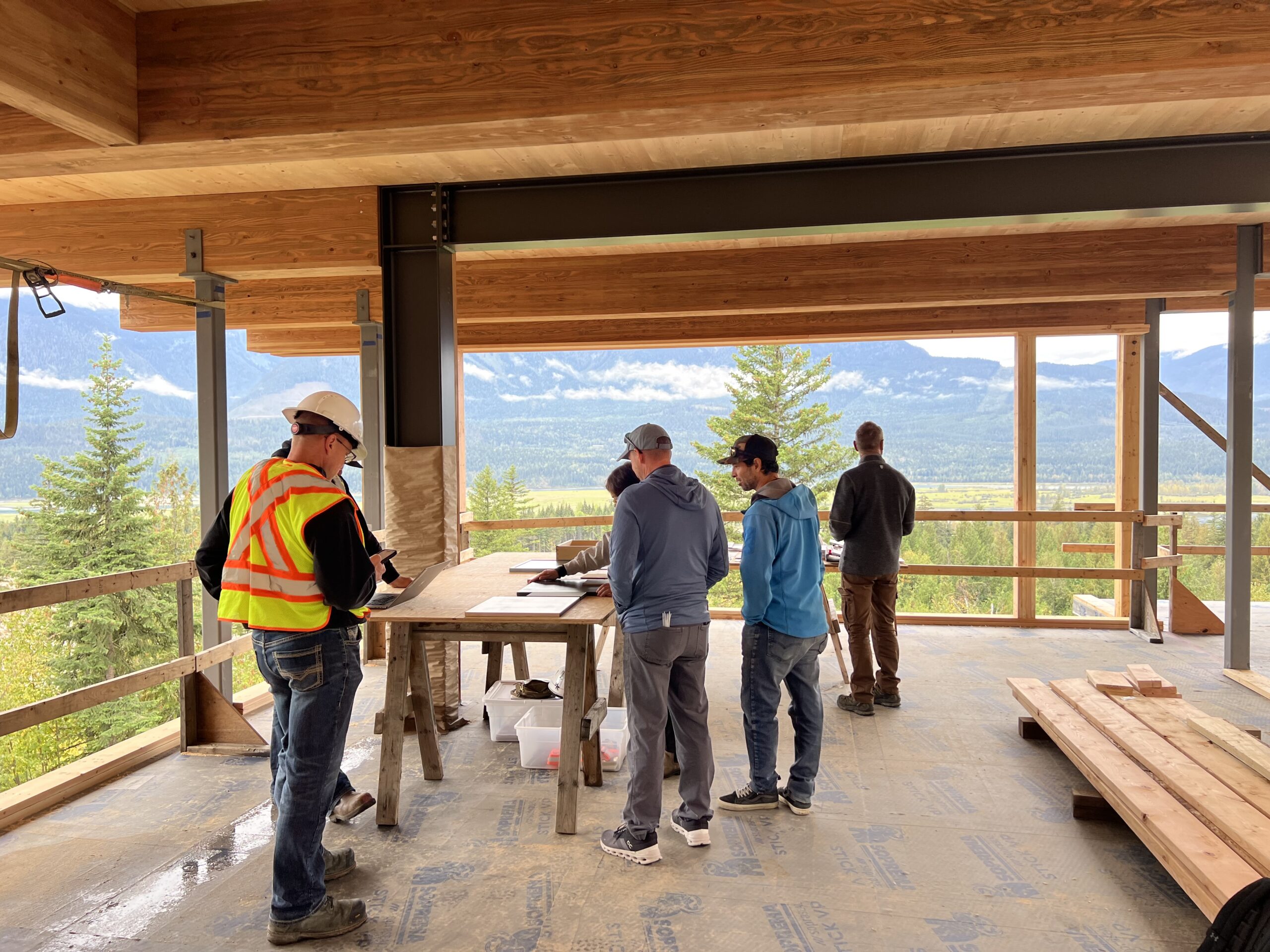
Owners planning to use design-build can begin researching design-build firms near me to review factors such as qualifications, experience, and team structure. They may also request design-build project timeline examples to understand how integrated delivery can help in scheduling and to ascertain homebuilding costs.
In British Columbia, owners working with a custom home builder in Golden or a Revelstoke contractor often choose design-build to simplify coordination between design and construction.
For an urban project, owners may seek out a Vancouver home builder or general contractor with experience in integrated project delivery.
HR Pacific operates as a Golden BC custom home builder and construction company in Revelstoke, using design-build to manage the scope, schedule, and cost from early planning through construction.
HR Pacific’s organizational models provide leadership continuity through a principal, directors, managers, and site supervisors. Contract selection depends on project needs and documentation. HR Pacific uses Cost Plus, enabling flexibility during design evolution and Guaranteed Maximum Price or Stipulated Sum contracts when drawings are completed.
Selection processes should assess experience with integrated delivery, including the ability to manage design coordination, cost control, and construction sequencing within a single team. HR Pacific’s organizational structure provides continuity across multiple projects through its established leadership team and a consistent subcontractor network.
Design-build contracts clearly define roles, responsibilities, and procedures, establishing clear decision-making authority, change management processes, and lines of accountability throughout the project lifecycle.
Owners and consultants benefit from training in design-build processes, particularly in areas such as scope definition, change management, and decision-making within an integrated team. When internal experience is limited, owners may hire external advisors or staff with expertise in integrated delivery to support governance, procurement, and early project planning.
Integrated delivery benefits from tools such as BIM, digital coordination platforms, and issue tracking systems. These tools support shared understanding, establish a single source of truth for project information, and reduce miscommunication.
Owners often begin with a pilot project to gain experience with design-build, particularly when the delivery method is new to the organization, and may start with smaller or less complex projects, such as single-family residential work. As project scale and complexity increase, particularly in infrastructure, healthcare, institutional, and industrial sectors, design-build is commonly applied to larger, more technically demanding projects where integrated delivery provides the greatest benefit at scale.
At the residential level, the same integrated approach supports coordination, cost visibility, and decision-making within a more focused project scope.
This step allows teams to refine workflows, develop comfort with integrated processes, and determine which project types are best suited to the method.