
The most critical phase of financial risk management begins the moment you step into the unit. While new construction is designed for longevity, the warranties that protect your investment are almost universally conditional upon a proactive long-term maintenance plan. Without a structured approach to upkeep, owners risk voiding their coverage, resulting in premature system failure and significantly higher repair expenses.
Key Takeaways
A warranty does not serve as a “catch-all” insurance policy, regardless of how the building is treated. In professional construction and facilities management, warranties are viewed as a partnership between the builder and the owner. Preventive maintenance, addressing issues before failure, often serves as the primary condition of this partnership.
For regional projects in Canada, particularly those in mountain environments like Revelstoke or Golden, climate and access can accelerate system wear and tear. A home maintenance schedule that aligns with these seasonal conditions is essential. By adhering to a structured building maintenance checklist, owners demonstrate the “reasonable care” required to keep builder warranties active.
In any warranty dispute or deficiency claim, the burden of proof often lies with the property owner. This is why organized project closeout documentation is indispensable. Professional contractors provide a comprehensive digital or physical package at project completion to support ongoing property management.
This “Paper Trail” typically includes:
This documentation establishes a clear reference point, allowing for efficient warranty coordination and management of corrective work with subcontractors and suppliers.
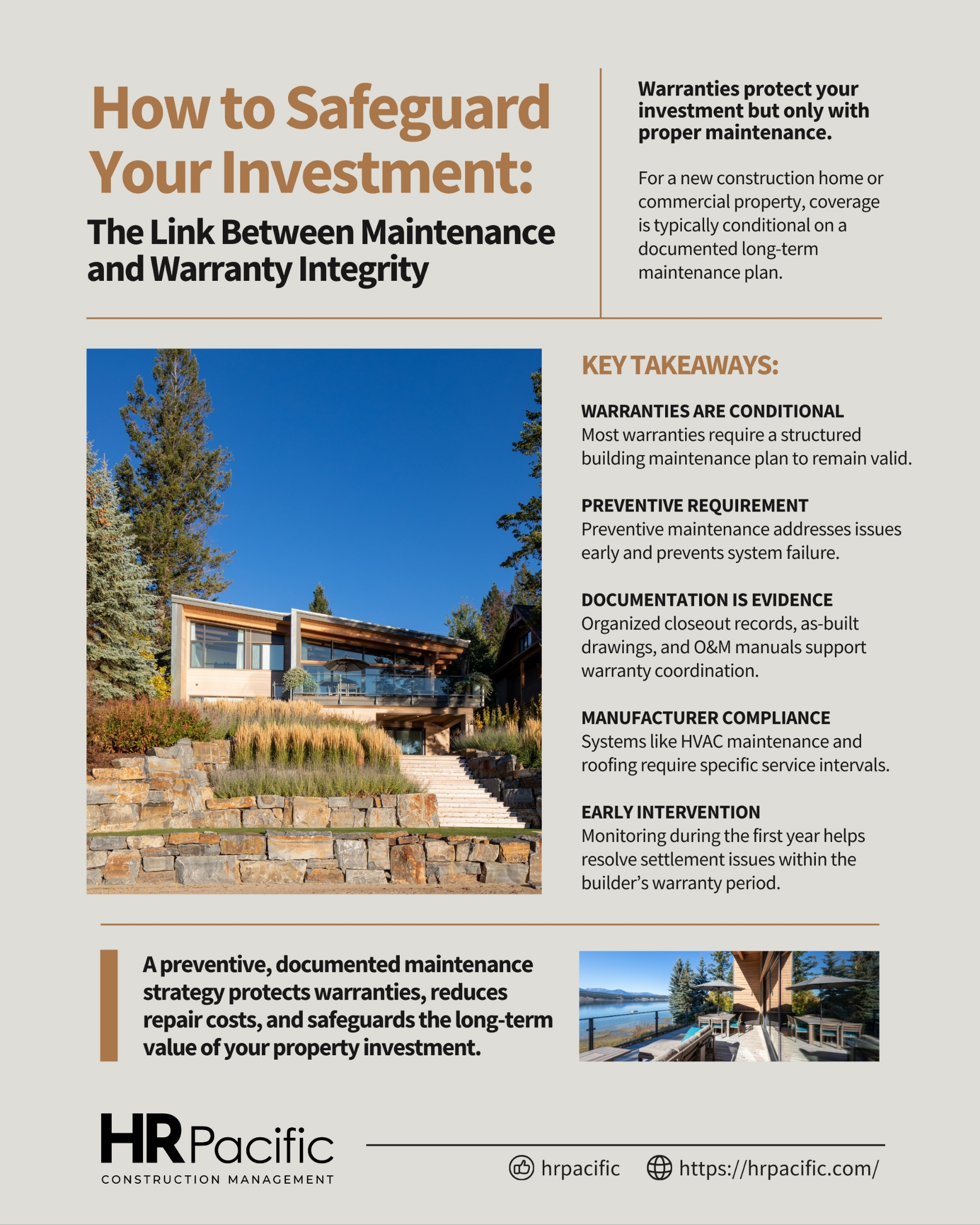
By treating your building maintenance plan as a mandatory extension of your warranty, you protect both the physical integrity of the structure and the financial health of your investment.
Manufacturer Requirements: Compliance for Major Systems
Beyond the general builder’s warranty, major building systems such as HVAC, plumbing, and roofing are protected by specific manufacturer warranties. These systems represent the most expensive components of a building and require specialized, scheduled care.
The transition from construction to operations is a high-risk period. Professional post-construction management focuses on system familiarization and owner orientation to ensure that facility managers understand these operational requirements.
By identifying critical first-year maintenance tasks and clarifying manufacturer requirements tied to warranties, owners can transition into a preventive maintenance mindset. This early monitoring period reduces the need for reactive maintenance and ensures that any early settlement issues are addressed while they are still the responsibility of the construction team.
Warranties provide peace of mind, but only to the owner who stays organized. By treating your building maintenance plan as a mandatory extension of your warranty, you protect both the physical integrity of the structure and the financial health of your investment.