Building a custom rental home in a remote mountain location like Golden, Revelstoke, or Invermere presents unique logistical hurdles. Traditional mountain sites often feature a “boneyard”: a cluttered area where excess materials sit for months, exposed to harsh alpine weather. However, for homeowners looking to protect their investment, the shift toward lean construction is ending the era of on-site stockpiling.
By implementing just-in-time construction (JIT), builders can transform a chaotic worksite into a precise, efficient assembly environment.
In the Canadian context, just-in-time construction is a procurement and delivery strategy that aligns material arrivals precisely with the project’s installation schedule. Instead of bulk-ordering everything at once, construction procurement is phased. This means your windows arrive exactly when the framing is ready to receive them, and your kitchen cabinetry lands just as the flooring is completed and the installation crew is ready.
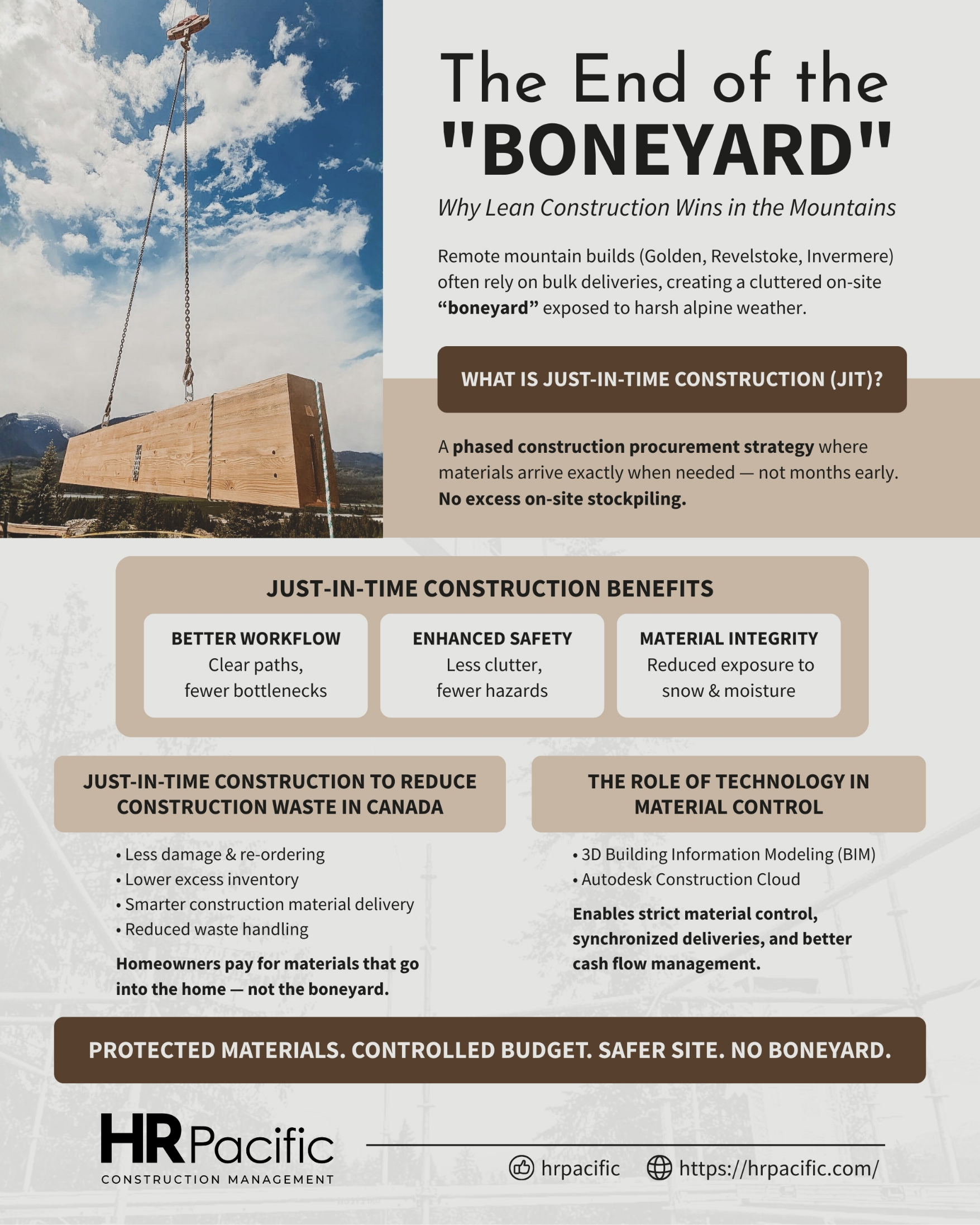
A quick breakdown of JIT
One of the primary advantages of JIT is the immediate improvement in site logistics. Mountain properties often have steep terrain and narrow access roads, leaving little room for a traditional “laydown zone”.
Construction activity is a major contributor to national waste generation. By using just-in-time construction to reduce construction waste in Canada, homeowners can ensure they are only paying for the materials that actually end up in their home and reduce losses caused by damage, deterioration, or unnecessary re-ordering.
Excessive inventory often leads to “waste through obsolescence” or damage. For example, drywall delivered three weeks early to a snowy site in the Kootenays is at high risk of water damage before it can even be hung. JIT serves as one of the most effective construction material handling reduction strategies, as it limits the number of times a product is moved between its arrival and its final installation.
Successful JIT relies on rigorous construction scheduling and digital tools. Companies like HR Pacific use 3D Building Information Modeling (BIM) and platforms like Autodesk Construction Cloud (ACC Build) to virtually test the delivery sequence before any materials are even ordered.
This digital foresight allows project managers to maintain strict material control, ensuring that construction material delivery is synchronized with the actual progress in the field. For you as the homeowner, this means better cash flow management: you pay for materials as they are used, rather than tying up capital in a boneyard of sitting inventory.
Transitioning to lean principles is not just about speed; it’s about a more controlled, predictable, and sustainable build. When your builder prioritizes JIT, they are choosing to protect your materials, maximize your budget, and maintain a site that is as pristine as the mountain environment surrounding it.